
Description of WHOTS-16 Mooring
3. Description of WHOTS-16 Mooring
The WHOTS-16 mooring, deployed on October 6, 2019, from NOAA’s Ship NOAA Oscar Sette, was outfitted with two complete sets of Air-Sea Interaction Meteorological (ASIMET) sensors on the buoy and underneath subsurface instruments from 7 to 155 m depth, at 1875 m and near the bottom. See [Santiago-Mandujano et al., 2021, Santiago-Mandujano et al., 2022] for a complete description of the buoy. The mooring could not be recovered in 2020 as originally planned due to ship availability and restrictions related to the COVID-19 pandemic. The WHOTS-16 recovery on August 28, 2021, resulted in about 692 days on station.
The buoy tower also contains a radar reflector, two marine lanterns, and Iridium satellite transmission systems that provide continuous buoy position monitoring. A Xeos Melo Global Positioning System (GPS) receiver, an SBE-39 temperature sensor adapted to measure air temperature, and a Vaisala WXT-520 multi-variable (temperature, humidity, pressure, wind, and precipitation) were also mounted on the tower. A fourth positioning system (Xeos Kilo transmitter) was mounted beneath the hull. Several other instruments were mounted on the buoy. A Battelle pCO2 system, a pumped SBE-16 CTD, and a SAMI-2 pH sensor were mounted to the buoy’s underside. A Sea-Bird SBE-63 hosted a dissolved oxygen sensor. Three down-looking radiometers were mounted on the buoy. One hyperspectral sensor is mounted facing upward near the radiometers as a reference for the incoming spectral irradiance. A Wetlabs ECOFLNTUS chlorophyll fluorometer was also mounted on the buoy hull.
Four internally logging Sea-Bird SBE-56 temperature sensors were bolted to the buoy hull’s underside, measuring sea surface temperature (SST) and salinity. The SBE-56s measured SST once every 60 sec between 80-95 cm below the surface. Two SBE-37 MicroCATs were at 1.50m measuring at every 300s (See Table 3.1).
Instrument |
SN |
Depth (m) |
Sample Interval (sec) |
|---|---|---|---|
SBE-56 |
7212 |
0.80 |
60 |
SBE-56 |
7213 |
0.80 |
60 |
SBE-56 |
7214 |
0.95 |
60 |
SBE-56 |
7215 |
0.80 |
60 |
MicroCAT |
1834 |
1.50 |
300 |
MicroCAT |
1841 |
1.50 |
300 |
Instrumentation provided by UH for the WHOTS-16 mooring included 20 SBE-37 Microcats, and two upward-looking RDI Workhorse ADCPs, transmitting in 300 kHz and 600 kHz,respectively. The Microcats all measured temperature and conductivity, with ten of them measuring pressure. All MicroCATs were deployed with antifoulant capsules. In addition to the buoy instrumentation, WHOI provided two Vector Measuring Current Meters (VMCMs), four deep Microcats ( SBE-37) installed at 1875 m and near the bottom of the mooring, and all required subsurface mooring hardware.
The Fig. 3.1 provides a listing of the WHOTS-16 subsurface instrumentation at their nominal depths on the mooring, along with serial numbers, sampling rates, and other pertinent information. A cold water spike was induced to the UH MicroCATs before deployment (Fig. 3.1) and after recovery Table 3.2 by placing an ice pack in contact with their temperature sensor to check for any drift in their internal clock. To produce a spike in the ADCP data, each instrument’s transducer was rubbed gently by hand for 20 seconds (Table 3.3 , and Table 3.4).
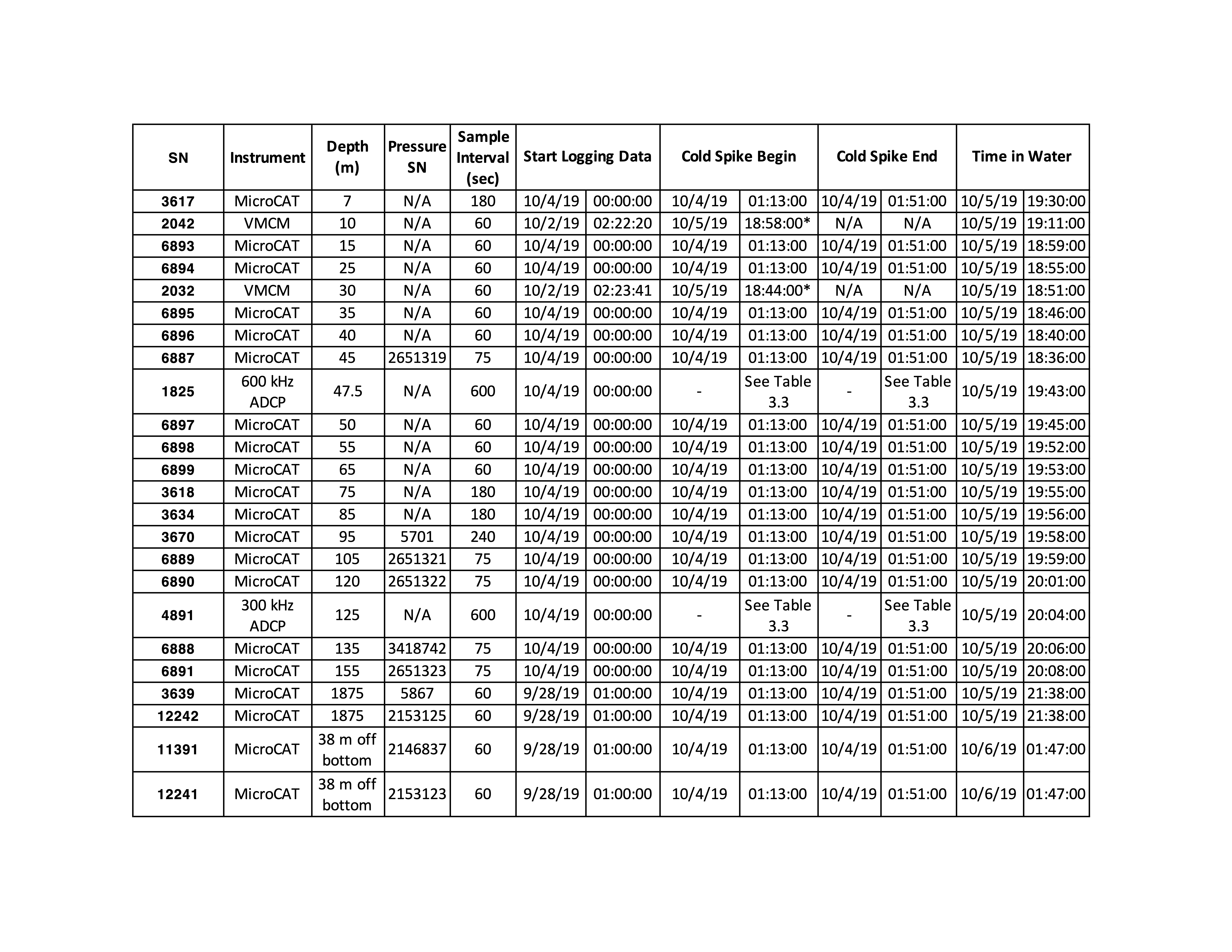
Fig. 3.1 WHOTS-16 mooring subsurface instrument deployment information. All times are in UTC
Depth (m) |
SN |
Time out of water |
Time of Spike |
Time of End Spike |
Time Logging Stopped |
Samples Logged |
Data Quality |
|---|---|---|---|---|---|---|---|
7 |
3617 |
8/29/21 3:17 |
8/29/21 6:48 |
8/29/21 7:48 |
1/31/21 10:42 |
233016 |
Good |
15 |
6893 |
8/29/21 3:18 |
8/29/21 6:48 |
8/29/21 7:48 |
5/8/21 12:58 |
838859 |
Good |
25 |
6894 |
8/29/21 3:22 |
8/29/21 6:48 |
8/29/21 7:48 |
5/8/21 12:58 |
838859 |
Good |
35 |
6895 |
8/29/21 3:31 |
8/29/21 6:48 |
8/29/21 7:48 |
5/8/21 12:58 |
838859 |
Good |
40 |
6896 |
8/29/21 3:31 |
8/29/21 6:48 |
8/29/21 7:48 |
5/8/21 12:58 |
838859 |
Good |
45 |
6887 |
8/29/21 3:32 |
8/29/21 6:48 |
8/29/21 7:48 |
1/31/21 10:47 |
559239 |
Good |
47.5 |
ADCP 1825 |
8/29/21 2:12 |
N/A |
See Table 3.4 |
1/21/20 |
15823 |
Failed on 01/21/20 |
50 |
6897 |
8/29/21 2:12 |
8/29/21 6:48 |
8/29/21 7:48 |
5/8/21 12:58 |
838859 |
Good |
55 |
6898 |
8/29/21 1:55 |
8/29/21 6:48 |
8/29/21 7:48 |
5/8/21 12:58 |
838859 |
Good |
65 |
6899 |
8/29/21 1:53 |
8/29/21 6:48 |
8/29/21 7:48 |
5/8/21 12:58 |
838859 |
Good |
75 |
3618 |
8/29/21 1:52 |
8/29/21 6:48 |
8/29/21 7:48 |
1/31/21 10:45 |
233016 |
Good |
85 |
3634 |
8/29/21 1:51 |
8/29/21 6:48 |
8/29/21 7:48 |
1/31/21 10:42 |
233016 |
Good |
95 |
3670 |
8/29/21 1:50 |
8/29/21 6:48 |
8/29/21 7:48 |
3/16/21 13:52 |
190650 |
Good |
105 |
6889 |
8/29/21 1:49 |
8/29/21 6:48 |
8/29/21 7:48 |
1/31/21 10:47 |
559239 |
Good |
120 |
6890 |
8/29/21 1:48 |
8/29/21 6:48 |
8/29/21 7:48 |
1/31/21 10:47 |
559239 |
Good |
125 |
ADCP 4891 |
8/29/21 1:44 |
N/A |
See Table 3.4 |
7/6/21 |
92393 |
Good |
135 |
6888 |
8/29/21 1:43 |
8/29/21 6:48 |
8/29/21 7:48 |
1/31/21 10:47 |
559239 |
Good |
155 |
6891 |
8/29/21 1:41 |
8/29/21 6:48 |
8/29/21 7:48 |
1/31/21 10:47 |
559239 |
Good |
1875 |
3639 |
8/29/21 0:52 |
8/29/21 6:48 |
8/29/21 7:48 |
7/21/21 0:19 |
190650 |
Good |
1875 |
12242 |
8/29/21 0:52 |
8/29/21 6:48 |
8/29/21 7:48 |
8/31/21 19:40 |
202689 |
Good |
38 mab |
11391 |
8/28/21 21:45 |
8/29/21 6:48 |
8/29/21 7:48 |
8/31/21 17:00 |
202657 |
Good |
38 mab |
12241 |
8/28/21 21:45 |
8/29/21 6:48 |
8/29/21 7:48 |
8/31/21 16:00 |
202645 |
Good |
- |
ADCP S/N 1825 |
ADCP S/N 4891 |
|---|---|---|
Frequency (kHz) |
600 |
300 |
Number of Depth Cells |
25 |
30 |
Depth Cell Size (m) |
2 m |
4 m |
Pings per Ensemble |
80 |
40 |
Time per Ensemble (min) |
10 min |
10 min |
Time per Ping (sec) |
2 sec |
4 sec |
Time of First Ping |
10/04/19, 00:00:00 |
10/04/19, 00:00:00 |
Transducer 1 Spike Time |
10/05/19, 03:30:00 |
10/05/19, 03:31:00 |
Transducer 2 Spike Time |
10/05/19, 03:30:15 |
10/05/19, 03:31:15 |
Transducer 3 Spike Time |
10/05/19, 03:30:30 |
10/05/19, 03:31:30 |
Transducer 4 Spike Time |
10/05/19, 03:30:45 |
10/05/19, 03:31:45 |
Time in Water |
10/05/19, 19:43:00 |
10/05/19, 20:04:00 |
Depth (m) |
47.5 m |
125 m |
ADCP S/N 1825 |
ADCP S/N 4891 |
|
|---|---|---|
Transducer 1 Spike Time |
N/A |
N/A |
Transducer 2 Spike Time |
N/A |
N/A |
Transducer 3 Spike Time |
N/A |
N/A |
Transducer 4 Spike Time |
N/A |
N/A |
Time out of Water |
08/29/21, 02:12:00 |
08/29/21 01:44:00 |
The RDI 300 kHz Workhorse Sentinel ADCP, SN 4891, was deployed at 125 m with transducers facing upwards with an additional external battery pack. This instrument was set to ping at 4-second intervals for 160 seconds every 10 minutes, and the burst sampling was designed to minimize aliasing by occasional large ocean swell orbital motions. The bin size was set for 4 m. The total number of ensemble records was 92,393. The first ensemble was on 10/04/2019 at 00:00:00Z, and the last was on 07/06/2021 at 14:39.59Z (see Table 3.3, Table 3.4, and WHOTS-16 300 kHz - Serial 4891 for more configuration). This instrument also measured temperature.
The RDI 600 kHz Workhorse Sentinel ADCP, SN 1825, was deployed at 47.5 m with transducers facing upwards with an additional external battery pack. The instrument was set to ping at 2-second intervals for 160 seconds every 10 minutes, and the burst sampling was designed to minimize aliasing by occasional large ocean swell orbital motions. The bin size was set for 2 m. The total number of ensemble records was 15,823. The first ensemble was on 10/04/2019 at 00:00:00Z, and the last was on 01/21/2020 at 20:49:59Z (see Table 3.3 , Table 3.4, and WHOTS-16 600 kHz - Serial 1825 for more configuration). This instrument also measured temperature.
The two VMCMs, SN 2042 and 2032, were deployed at 10 m and 30 m depth, respectively. The instruments were prepared for deployment by the WHOI/UOP group and set to sample at 1-minute interval. These instruments also measured temperature.
All WHOTS-16 instruments were successfully recovered; recovery information for the C-T instruments is shown in Table 3.2. Most of the instruments had some degree of biofouling, with the most substantial fouling near the surface. The fouling extended down to the ADCP at 125 m, although it was minor at that level.
All MicroCATs were in good condition after recovery, although with more biofouling than usual given that they were in the water for nearly 2 years. MicroCAT SN 6899 (65 m) had a barnacle partially blocking the top of its conductivity cell.
After recovery and before stopping recording, a bag of ice was placed in contact with each MicroCAT temperature sensor, to produce a spike in the data as a reference point to check the instrument’s clock. However, it was later found that all the instruments had stopped logging data due to battery drainage, except for the deep instruments. The data from all instruments were downloaded on board the ship, the instruments returned data records ending as early as January 31, 2021. Table 3.2 has an initial evaluation of the data quality; more details are in MicroCAT Data Processing Procedures, and MicroCAT Data.
The data from the upward-looking 300 kHz ADCP at 125 m were good; the instrument was not pinging upon recovery and the data record indicates that it stopped recording on July 6, 2021. There appears to be no obviously questionable data from this ADCP at this time, apart from near-surface side-lobe interference. The 600 kHz instrument (47.5 m) was recovered with its battery wire cut and separated from the instrument. The data record indicates that it stopped recording on January 21, 2020.